Showing posts with label homework. Show all posts

Tuesday, April 26, 2016

Preparing for Exams (and other tests)

With summer just around the corner, students (and parents) may be starting to think about end-of-year exams. No need to panic though! Keep in mind the following to get through exam season without a hitch...


An organized visual schedule can be
a great cue or prompt
for sticking to your plan
Time Management is Essential! 
  • Find blocks of 30-45 minutes in your schedule, and then plan what to focus on during those blocks of time.
  • Map out the “what” AND the “how." 
    • Doing this in advance can save you time (and stress) later on. 
    • Build in a short break (2-5 minutes) for every 45-60 minutes of studying.
    • Use a timer so your breaks don't get too long!
  • Prepare by first collecting content from which to study; then, create study materials; then, actively engage with and utilize those study materials. (More tips about this are below.)
  •  Some teachers will work with you in class, to prepare for exams, and may even give you a timeline and specific tasks to do for preparation. Stick to those recommendations!


Keep a Balanced Perspective
  • Keep these tests in perspective.
  • Focus on the process, versus the product
    • This means emphasizing the habits that you are working to develop, and the process of figuring out the sorts of study techniques that work best for you as an individual, rather than solely emphasizing the grade you end up with.
    • Focus on HOW you're studying, rather than HOW MUCH you study.
  • Maintain healthy habits: eat well-balanced meals, get plenty of sleep, stay active, and continue to participate in the things you enjoy!


Use ACTIVE Study Strategies
“Reading over” textbooks and notes is NOT efficient studying!

Chunk Down” the Content- Break large amounts of material into smaller pieces. Before setting out to attack your class material, color code or label it. Divide the material into what you know well (green)what you need to review (yellow)and what is unfamiliar (red).
 You can also consider breaking down your material into the categories outlined on a study guide given to you by your teacher, or according to how recent the material is.


Teach Someone Else-You’ll know that you’re really comfortable with the material if you can teach it to someone else. Teach a parent or sibling, encourage them to ask you questions...and then answer their questions.

CREATE Study Materials  
  • Using pre-made Quizlet sets is okay, but you may retain more when you’re creating the study materials instead of just reviewing what someone else has done.
    A graphic organizer, filled in or entirely created by you,
    can be a great way to see the big ideas
    and connections in your class material. 
  • ŸGraphic Organizers: For many classes, it can make sense to create a graphic organizer or visual that shows the connections between the content/ topics that you have studied this year. Creating a graphic organizer can help you to not only see how the topics are connected, but can also help you to identify “big ideas” to focus on. 
  • ŸNote Cards: On the front, write the term, big idea, event, etc. On the back, answer who, what, when, where, why is it significant questions. Does it take longer? Yes, but you will have a more thorough understanding of the material. 
  • Create a visual trigger on the front of the note card. This can be a phrase or picture, or some other sort of mnemonic. In the testing situation, the visual trigger may be just the thing that pops into your mind and cues the answer.
  • Play with the note cards. Rather than just flipping through and trying to memorize the words on the card, get creative. Make different groups and categories (e.g. leaders and battles; bones and organs; verbs and nouns) then re-categorize them. Compare the cards to one another. How were 2 leaders the same or different? Why was one battle more significant than others? By manipulating the note cards, you are engaging in higher-level thinking…the sort of skills you’ll need to practice in order to answer essay and other open-response questions.
  • ŸTriple Note Totes: These are useful when you’re working on memorizing material. Fold a paper into three columns. In the first column, list the vocabulary you’re trying to remember. In the middle column, write the definition or important information about that term. In the third column, create and note down a mnemonic device for linking the term to the necessary information (definition, dates, importance, etc.).
Test Yourself- You’ve have had a whole year’s worth of experience taking tests and quizzes for a class, so you can use those old assessments to study from. You can:
    • Make corrections to old tests and quizzes, using your notes and textbooks.
    • Make up your own practice questions based on the sorts of questions teachers have used in the past.
    • Look at chapter titles or section headings in a book, and turn them into essay questions.
    • Turn class notes into fill-in-the-blank or short answer questions.
    • Make practice tests to exchange with classmates.
Form a Study Group- Study groups can be good for reinforcing material you already know, and provide you with an opportunity to practice and review what you’re not as comfortable with. However, you must keep them structured and focused, in order for group meetings to be useful.

Have additional tips for dealing with exams? Share in the comments below!


Wednesday, November 4, 2015

Following Directions


Many students only skim through, or skip over altogether, the directions for an assignment. 

This can obviously cause you some problems: you may do the work incorrectly and need to re-do it, you may do too much work and be wasting your time, or you may not do all of the work that is required. 

There are a few strategies, however, that you can use to make sure you're paying close attention to all parts of directions, and following them correctly. Those strategies include:

1. Reading the directions twice before starting. Then, re-read the directions when you think you're done, to make sure you followed them correctly.

2. Asking yourself, "How would I explain these directions to someone else, using my own words?" If you're not able to do that, it may mean you don't truly understand the directions. So, ask for help or try another strategy.

3. Highlighting or underlining key words in the directions.

  • Pay close attention to words like: 
    • (English/ History/ Science) Read, underline, circle, summarize, explain, provide details, write in complete sentences, brainstorm, analyze, compare, contrast, prove, describe, annotate, mark up, support...
    • (Foreign Language) Translate, summarize, explain, write in complete sentences, describe...
    • (Math) Find the product/ sum/ quotient/ remainder, simplify, show your work, diagram, demonstrate...

Sometimes, teachers will make bold, underline, or italicize the most important words in directions, so pay close attention to those signals too!

4. Highlighting, underlining, or circling signs and symbols (x, -, +, =,  ÷) in math problems. If you treat something like an addition problem when it's really a multiplication problem, you're obviously not going to get the correct answer. Color-coding signs for addition, multiplication, subtraction, and division, can be another cue to pay close attention to the signs.

5. If there is more than one step to the directions, you should identify each different step you should take. For example, in the following directions, you're being asked to do three things:
Identify three inventions of the industrial revolution, explain how each invention changed the way people lived, and summarize what life would be like today if these inventions did not exist. 

By highlighting or numbering each step, you're going to be more likely to follow each of the three sub-directions and produce a more complete answer.
Identify three inventions of the industrial revolution, explain how each invention changed the way people livedand summarize what life would be like today if these inventions did not exist. 

Try out one or more of these strategies if you often hear from teachers that you need to pay close attention to the directions, or if you see that your errors are not really reflective of what you actually understand. 

If you have other ideas or strategies for following directions, please leave a comment to share!


Friday, October 16, 2015

Quick Tips for Creating a Space that's Conducive to Studying


It's important to have an organized space where you can consistently complete your homework and studying. Having fewer distractions and knowing where to find necessary materials will help you to complete your work more quickly, and allow you to have time to do the things you want to do! Taking a few minutes to read through these simple tips might just put you on the path to a shorter and more efficient homework time!

I'm going to try to keep this post streamlined and organized, just like a study space should be...                                                                               

Workspace


  • Have a set study space and storage space
    • The storage space should ideally be in the study space, but it could also be a shelf or cabinet or bin in another room. 
    • Keep your materials and textbooks in the same place all the time, when at home. Ideally, this place should be a specific location within your study space.
  • If you split your time between two homes, or don't always have an opportunity to do your homework in the same place each day, create a "workspace bag/bin" that contains everything you'll need for a mobile workspace. 
    • The bag or bin will keep everything together, and is easily portable. 
    • Only take things out of the bag or bin when you're using them in that moment. Then, put the item back right away so you'll know where to find it when you need it next.
    • This is not so good...
    • Keep this workspace bag/bin in one place (e.g. trunk of a car).
  • Reduce clutter in your work area. 
    • You should work on a clear, uncluttered surface. 
    • After unpacking your bag, put one subject's materials on the surface at a time. Leave the other materials off the work surface, so you have reduced the "visual noise." 
  • Adjust furniture to fit your needs.
    • Sit in a comfortable chair (with armrests, if you're working at a computer), that allows you to maintain good posture: sitting up straight with your feet flat on the floor or on a footrest.
    • When you're working on the computer, your eyes should be about 1.5 feet from the screen (about arms' length)
      • The keyboard should be centered and on a stable surface
      • The monitor should be about 5cm above eye level. 
      • Zoom in on what you're looking at or working on, and adjust the settings so messages aren't popping up and you're not receiving notifications irrelevant to your task.


Routines


  • Unpack everything from your backpack and file away old materials at a routine time
  • I'm pretty sure you don't want your work
    area to end up looking like this.
    • File old papers and tests. Don't throw away materials or past assessments unless your teacher says to; these materials may come in handy when you're preparing for mid-year or final exams.
    • Use accordion folders, separate binders, or a giant binder with dividers to keep old work organized by subject and topic. Put these in your storage space so they're not cluttering up your work space, but they're still available for reference when needed.
    • You could do this every day, at the end of every school week, or even on Sundays when you're preparing for another week at school. It doesn't really matter when; the important thing is that you do this at least 1-2 times per month, depending on how many papers you have in your binders or folders.  
  • Set aside time at the beginning of each work session to review your planner and to check (using the classroom websites, if possible), that you know what you have to accomplish that night.
    • Then, make a plan of approach: What will you start with? What will you do next? When, and for how long, will you take a break? Plan this out in writing, and stick to it.

Environment

  • Reduce and/or remove distractors in your work area.
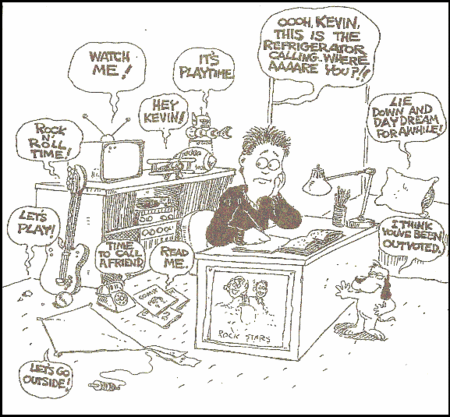
  • Look familiar? It does to me!
    • Put your phone in a different room
    • Keep the computer screen turned off unless you're using it for homework
    • Pull down the shades/ blinds if you're facing a window
    • Turn off the TV or music
  • Make sure you have adequate lighting, so your eyes don't have to work as hard.
  • Get some fresh air in the room if possible.


Good luck!


Wednesday, September 30, 2015

Using your planner!!!

The key to effectively using a planner is consistency: use it well and use it always. If you only use your planner once in a while, or don't use it to write down homework in each and every class, it's probably not going to be helpful to you. But, if you do use it well and use it consistently, you will likely find that you are less stressed about schoolwork, you're getting better grades, and you're enjoying your classes more because you're prepared and more relaxed!


Backwards planning for long term projects, and upcoming tests and quizzes works like this:
1. Start by writing down when the assignment is due, or when the test/quiz is. Write this in on the day it's due/ being given.
2. Count back the days you have to work on it; that is, count backwards from the due date to today.
3. Think about the amount of material you have to produce, or review to prepare for the test or quiz. Divide it into chunks that make sense for whatever the assignment it. For example, if you have a math quiz on chapter 1, sections 1-3 four days from now, maybe you chunk down the material into sections (one per night), then use the fourth night to review all of the sections together. If you have a first draft of a five-paragraph essay due three days from now, maybe you work on brainstorming and outlining tonight, writing the three body paragraphs tomorrow, and then writing the intro and conclusion the next night.
4. Write down EXACTLY what you will work on each night, and how you will "work on" it. Writing "study" in your planner doesn't really remind you of what you should be DOING to study. Instead, write down "make flashcards and play mix-and-match game with flashcards" or "make and complete an active practice on section 1."

The idea behind backwards planning is to get larger assignments or tasks done by attacking it in smaller and more manageable pieces, in the days leading up to a due date or an assessment date. Practicing backwards planning can help you to see a large assignment as more manageable, and it can also help you to not procrastinate on the work! Above is a video that shows an example of backwards planning in practice.

Estimating the amount of time each nightly assignment will take, and writing down that estimation, can help in two ways: first, it can be a goal to then complete the assignment in that amount of time, which may lead you to be more efficient and focused; second, it can help you to get an idea of when you should work on each task. For example, if you think that reading a chapter for English will take you about 20 minutes, and writing a response for History will take you about 30 minutes, and you know that you have only 20 minutes left before having to eat dinner, you could complete English in that amount of time rather than feeling interrupted when working on history. Also, generally speaking, the longer something is going to take, the more brainpower it is going to require. So, it's often a good idea to complete longer assignments before working on shorter ones.

Plan out the order in which you'll complete your assignments, before beginning them. Simply numbering assignments or subjects 1, 2, 3, ... can help you to feel like you have a road map to your nightly homework. Again, for most people, it works best to start with the most difficult assignments first, because that's when they have the most brainpower or mental energy. However, other students report that starting with something they like, or something that's relatively easy, works well because they feel like it's motivating and it gets them on a roll with their work, and gives them confidence in their ability to complete the work (even when the later assignments are more difficult).